Trailing drawdown: how it moves and where your floor sits
A trailing drawdown is a loss floor that follows your highest balance up and never moves down. Work out where it sits before each session, how end-of-day and intraday rules differ, and when it locks.
We use cookies, including analytics, to improve Tradeways. · Privacy
A trailing drawdown is a loss limit that follows your account's highest value up at a fixed distance and never moves down. Your floor is that high minus the allowed drawdown, and some rules stop trailing once the floor reaches a set level, such as the starting balance. Before each session, write down three numbers: the floor, your balance, and the cushion between them. The cushion is how much you can lose before the account breaches.
Two details decide where the floor sits: which high the rule follows, and whether it has locked. This guide walks one account through both common variants so you can compute your own floor.
The variants differ in what counts as the "highest value" and in when the floor stops moving.
Rule detail
End-of-day trail
Intraday trail
Highest value
Highest closing balance of a session
Highest account value during the session, open profit included
Floor moves
Once, after the session closes
Immediately, whenever the account makes a new high
Open profit
Does not move the floor
Moves the floor, even if the trade later gives it back
Lock
If the rule has one, at the level it sets
If the rule has one, at the level it sets
Both variants are in use. As of 12 October 2026, Funded Futures Family's drawdown page describes one end-of-day drawdown, calculated from the highest closing balance, and one intraday drawdown, calculated from the highest value including profit on open positions.
Moving the floor and enforcing it are separate. As of 12 October 2026, Topstep's Maximum Loss Limit page says its limit trails the end-of-day balance and locks once it reaches the starting balance. The same page says the limit is monitored in real time, unrealized P&L included, so an open loss that touches the floor liquidates the account even if the trade would have closed above it. An end-of-day rule therefore does not mean you can sit below the floor during the session.
The account below is hypothetical: 50,000 USD starting balance, 2,000 USD maximum drawdown, and a floor that locks at 50,000 USD once the high reaches 52,000 USD. Balances are after fees. The two columns apply the end-of-day rule and the intraday rule to the same trades.
Session
What happened
Closing balance
End-of-day floor after
Intraday floor after
Start
No trades yet
50,000
48,000
48,000
Day 1
One trade ran to +1,200 open profit, closed at +400
50,400
48,400
49,200
Day 2
One trade closed −600; the account made no new high
49,800
48,400
49,200
Day 3
Closed +2,500; the open high during the session was 52,600
52,300
50,000 (locked)
50,000 (locked)
On day 1, the end-of-day rule moved the floor only by the closed result: 50,400 − 2,000 = 48,400. The intraday rule moved it to 51,200 − 2,000 = 49,200 while the trade was open, and the 800 USD of open profit the trade gave back did not move it down again.
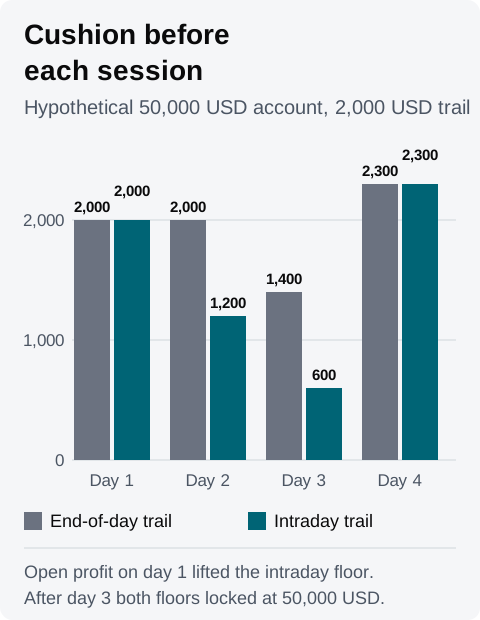
Day 2 had no new high, so neither floor moved. The loss came out of the cushion. Under the intraday rule, that left 600 USD before day 3: 49,800 − 49,200.
On day 3, both highs passed 52,000, so both floors would have trailed above the starting balance and locked at 50,000 instead. From day 4 on, the cushion moves one-for-one with the balance, down as well as up.
Hypothetical account. The intraday rule left 600 USD of cushion before day 3, the end-of-day rule 1,400 USD, from the same trades.
The same trades left the intraday account with less than half the cushion before day 3. If your rule trails intraday, an open trade that runs into profit and comes back costs cushion even when it closes positive.
A static drawdown keeps its floor at the starting balance minus the limit for the whole evaluation. In the example, a 2,000 USD static limit stays at 48,000 USD on every day. A trailing limit starts at the same place and only moves up, so before it locks, the trailing floor is always at or above the static one.
Maximum drawdown describes the deepest decline your account has already had. A trailing drawdown limit is a rule about the future: it sets how far the next decline may go from the current high.
Rule: what the high includes (closing balance or open profit), and the lock level, from your firm's rule page.
High: the highest value under that rule so far.
Floor: high minus the maximum drawdown, or the lock level once it has locked.
Cushion: current balance minus the floor.
Losses that fit: cushion divided by your planned risk per trade.
Before day 3 in the intraday example, the cushion was 600 USD. With 250 USD risk per trade, two full losses fit and a third would breach. With 400 USD risk per trade, only one fits. The cushion does not tell you what size to trade; it tells you how many planned losses the account can absorb. The position sizing guide covers setting the risk per trade.
If the rule trails intraday, also note the largest open profit you would let a trade give back. On day 1, the giveback from 1,200 to 400 USD cost 800 USD of cushion that the end-of-day rule did not take.
In Tradeways, a goal can hold a Max drawdown constraint with the basis Trailing, then locked. Set the maximum drawdown, the Lock trigger (the high at which the trail stops, 52,000 USD in the example), and the Locked floor (50,000 USD). Prop-firm templates in Manage goals create these rules for you, and a template lists the rules it cannot evaluate under "Some rules still need manual tracking". The constraint card shows how much of the limit the closed trades have used at their worst point: on day 2 of the end-of-day example, 2,000 − 1,400 = 600 USD. The constraint turns At risk once 75% of the limit is used and Breached when a closed balance falls below the floor.
Tradeways evaluates the goal from closed trades. It recalculates the high and the floor after each closed trade, not from open positions and not once per session. That gives three differences from your firm's account:
Your firm's rule
How the Tradeways floor can differ
Intraday trail
Lower than the firm's floor. On day 1, the goal's floor is 48,400 USD because it never saw the 51,200 USD open high; the firm's floor is 49,200 USD.
End-of-day trail
Higher than the firm's floor when one session holds several trades. In a session that starts at the high, a +900 USD close followed by a −500 USD close raises the goal's high by 900, the firm's by 400.
Breach on an open loss
Not shown. An open loss that touches the firm's floor is a breach even if the trade closes above it; the goal sees only the closed result.
The firm's account dashboard decides whether you breached. Use the goal as a second record built from your closed trades, and compare its numbers with the firm's before each session; when they differ, the table above shows the usual reason.
The goals documentation explains every drawdown basis and status. A drawdown floor describes how much loss the account allows; it does not predict results. Read the Tradeways risk disclosure before you use your trading history to support a decision. If your evaluation also caps how much of your profit one day may contribute, the consistency rule guide shows how to calculate it.
See how goals track prop-firm rules, then add your firm's drawdown rule and compare its floor with your account dashboard before the next session.