Prop firm consistency rule: how to calculate it and the profit you still need
A consistency rule caps how much of your total profit one day may contribute. Calculate your best-day share, the total profit the rule requires, and how large your next day can be.
We use cookies, including analytics, to improve Tradeways. · Privacy
A prop firm consistency rule limits how much of your total profit can come from your single best day. Your best-day share is your best day's net profit divided by your total net profit. If the limit is 40% and your best day made 1,500 USD, your total profit has to reach 1,500 ÷ 0.40 = 3,750 USD before the share is inside the limit.
Three numbers answer most consistency questions: the share you have now, the total profit the rule requires, and how large your next day can be without making things worse. This guide works through all three on one account.
You are not payout eligible yet; keep trading until the share falls
Example on the page
A 1,800 USD best day raises a 3,000 USD target to 3,273 USD
A 3,600 USD largest day ÷ 9,500 USD total net profit = 37.9%, eligible
Other conditions
Profit needed after a raise has to be earned on a separate, later trading day
At least 3 trading days; the calculation resets after a payout request
Under an evaluation rule, the profit you need is the larger of the profit target and best day ÷ limit. On the same page, Topstep lists less than 1,650 USD as the best-day level that keeps a 3,000 USD target from rising, which is 55% of the target. The page also says that a best day locks at 3:10 PM CT, so the firm's trading day is not your calendar day.
Your firm's limit, day definition, and reset rule may differ from these. Take them from your own firm's rule page.
The account below is hypothetical, with a payout rule of 40%. Day results are net of fees in USD.
Day
Day net P&L
Total net profit
Best day
Best-day share
Total the rule requires
Still needed
1
+600
600
600
100.0%
1,500
900
2
+1,500
2,100
1,500
71.4%
3,750
1,650
3
−400
1,700
1,500
88.2%
3,750
2,050
4
+700
2,400
1,500
62.5%
3,750
1,350
5
+900
3,300
1,500
45.5%
3,750
450
6
+800
4,100
1,500
36.6%
3,750
0
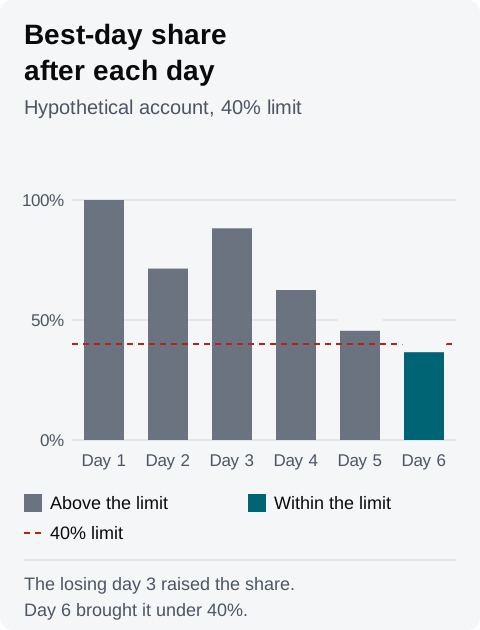
Day 2 set the best day, and from then on the account needed 3,750 USD in total. The losing day 3 did not change the best day; it lowered the total by 400 USD, raised the share from 71.4% to 88.2%, and added 400 USD to the profit still needed. Day 6 brought the share to 36.6%, inside the 40% limit.
Hypothetical account. The losing day 3 pushed the share up; only day 6 brought it under the 40% limit.
A new day helps only within a range. Too small, and the total stays short of what the rule requires. Too large, and the day becomes the new best day and raises the requirement.
Smallest next day = profit still needed
Largest next day = limit × total net profit ÷ (1 − limit)
Before day 5 in the example, the total was 2,400 USD and 1,350 USD was still needed. The largest next day was 0.40 × 2,400 ÷ 0.60 = 1,600 USD. Any day from 1,350 to 1,600 USD would have brought the share inside the limit. Day 5 made 900 USD, so a sixth day was needed.
Before day 3, the account still needed 1,650 USD, more than the 1,500 USD best day. In that case, no single day can fix the share: a day large enough to cover what is still needed becomes the new best day and raises the requirement with it. The formulas show it too: the largest next day was 0.40 × 2,100 ÷ 0.60 = 1,400 USD, below the 1,650 USD still needed, so the range was empty. The account needed at least two more profitable days.
These are limits on the result, not targets to trade for. They tell you which outcomes would satisfy the rule; they do not tell you what size or how many trades to take. Under an evaluation rule like the Trading Combine's, the largest day that leaves the target unchanged is simply the limit times the profit target.
Rule: the limit, whether it raises a target or decides payout eligibility, how your firm defines a trading day, and when it resets.
Best day: your largest net profit day under that day definition.
Total: total net profit since the start or the last reset, losing days included.
Share and still needed: best day ÷ total, and best day ÷ limit − total.
Range for the next day: from the profit still needed to limit × total ÷ (1 − limit). If the profit still needed is larger than your best day, plan for at least two more days.
In Tradeways, a goal can hold a Consistency constraint: no single day may exceed the share of total profit you set. Prop-firm templates in Manage goals create it with the firm's percentage. The constraint card shows your current best-day share against the limit.
The goal works from the net P&L of your closed trades, grouped by calendar day in your Tradeways timezone. Until the total is positive, the card shows N/A with the note "Consistency only applies once the period is profitable." Above the limit, the constraint shows Breached. Once the share is 75% of the limit or more, it shows At risk: with a 40% limit, from a 30% share. On day 6 of the example, the share of 36.6% is inside the limit and still shows At risk.
Your firm's rule
How the goal can differ
Trading day
The goal uses calendar days in your timezone. A trade closed after the firm's session cutoff can count toward a different day. The Topstep template lists this as a rule to track manually.
Open positions
The goal sees closed trades only. It does not show a best day that is still growing while a position is open.
Over the limit
The goal shows Breached and recovers as the share falls. It does not raise your profit target; compute the total the rule requires yourself.
Reset after a payout
The goal does not reset. Create a goal with a Fixed window that starts on the first day of the new payout window.
The firm's dashboard decides whether you passed or are payout eligible. Use the goal as a second record built from your closed trades, and compare its share with the firm's before each session.
The goals documentation explains every constraint and status. A consistency calculation describes your past results; it does not predict the next session. Read the Tradeways risk disclosure before you use your trading history to support a decision. For the drawdown limit, see the trailing drawdown guide.
See how goals track prop-firm rules, then add your firm's consistency limit and compare the share with your account dashboard before the next session.