We use cookies, including analytics, to improve Tradeways. · Privacy
Risk of ruin (RoR) is the probability that an account hits a defined drawdown threshold before its statistical edge has time to play out. It is the portfolio-level companion to per-trade MAE. MAE tells you how much heat a single trade can absorb. RoR tells you how much heat the account can absorb before it stops being one.
RoR is a closed-form answer to one question: given an edge, a per-trade risk fraction, and a drawdown threshold, what is the probability of hitting the threshold? Two desks running the identical strategy can sit at radically different RoR numbers. The strategy decides long-run profitability. The sizing decides survival.
Every edge produces losing streaks. A 55% win-rate system still throws runs of five, six, seven consecutive losses, because that is what an independent Bernoulli process does. The streak is not a defect. The defect is taking it at a per-trade risk fraction that breaches your drawdown threshold before the distribution mean-reverts.
For fixed bet size with normalized edge, the standard approximation is:
RoR = ((1 - Edge) / (1 + Edge)) ^ U
where U is the number of capital units between current equity and the ruin threshold (account size divided by risk per trade, scaled to whatever drawdown you call ruin), and edge is normalized for asymmetric payoffs:
Edge = (WR × RR − LR) / (WR × RR + LR)
with WR the win rate, LR the loss rate, and RR the average win divided by the average loss (R-multiple). This is the Vince form. For symmetric 1:1 outcomes it collapses to Edge = WR − LR. The closed form is the right tool for sizing decisions, not for precise tail estimates. For non-normal return distributions, Monte Carlo it.
Worked example. Strategy: 55% win rate, average win 1.5R, average loss 1R.
At 1% per-trade risk against a 20% drawdown threshold, U = 20 / 1 = 20 units, and RoR = (0.706 / 1.294)^20 = 0.5456^20 ≈ 0.05%. Move per-trade risk to 5%, U = 4, and RoR ≈ 8.9%. The strategy did not change. The survival probability collapsed by more than two orders of magnitude.
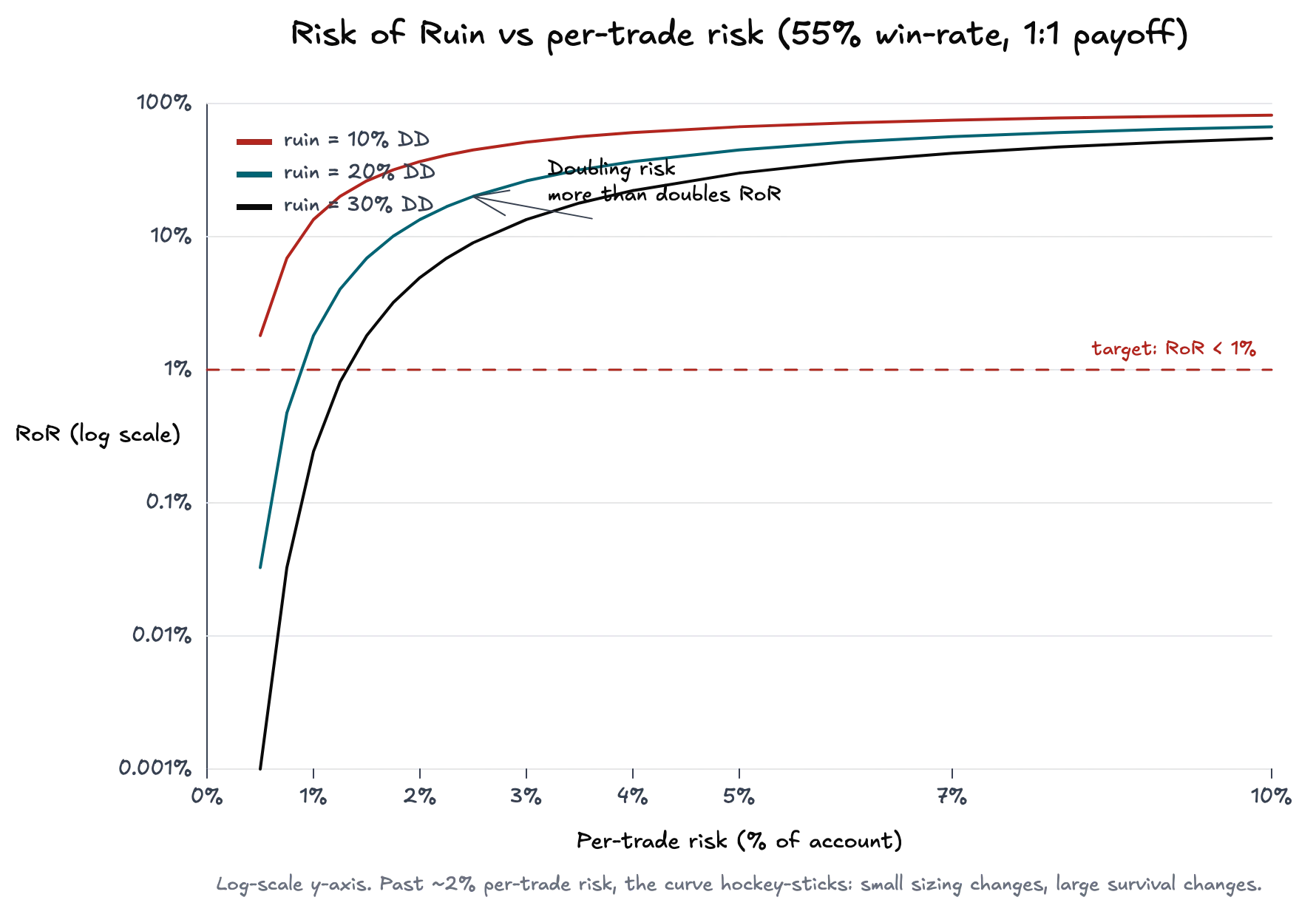
Doubling per-trade risk more than doubles RoR. That is the whole point of the chart.
The exponent in the formula is the number of capital units to ruin. Doubling risk halves the units. The base is less than one, so halving the exponent is a square root, not a halving. RoR roughly squares each time U is halved. The curve sits near zero up to about 1 to 2% per-trade and then bends sharply upward. Past 3%, even strong edges struggle to keep RoR below the 1% institutional ceiling.
Three curves, three drawdown thresholds, one edge. The hockey-stick after ~2% per-trade risk is structural, not stylistic.
The risk you plan and the risk you take are not the same number. A wide MAE distribution means trades routinely absorb more heat than your stop budget, through slippage, spread widening, or stops getting bypassed on news. Effective per-trade risk is your planned risk plus the right tail of your MAE distribution. Feeding the planned number into RoR understates ruin probability.
MAE and RoR belong on the same dashboard. MAE audits per trade how clean your stops actually are. RoR is the portfolio-level consequence. Tighten MAE and RoR improves without changing a single sizing rule.
Ruin is not zero balance. Ruin is the drawdown beyond which you stop being able to execute the strategy. For some traders that is 30%. For most professionals it is closer to 20%. For prop accounts it is set externally, usually 5 to 10%.
The workflow is to fix the drawdown threshold first and back out the per-trade risk. Targeting RoR below 1% on a 0.29 edge and a 20% drawdown threshold means solving 0.5456^U = 0.01 for U, which gives U ≈ 7.6. Risk per trade then sits at 20 / 7.6 ≈ 2.6%. Cut the threshold to 10% and the max per-trade risk drops to 1.3%. Cut the edge in half and even 1% per-trade starts looking aggressive.
This inverted form is the one that matters in practice. You do not pick a per-trade risk and see what RoR falls out. You pick the survival probability you require and the drawdown you can sit through, then read off the per-trade risk.
A few traps that show up the first time desks run this calculation.
Assuming independence. The formula assumes trades are independent. Correlated positions (three NQ shorts at the same level, four FX longs against USD) collapse U because losing trades cluster. Treat correlated positions as a single sized unit, not multiple.
Win rate without payoff. A 70% win rate looks safe until you discover the average win is 0.5R and the average loss is 1R. The R-multiple matters more than the hit rate. Run the normalized edge, not the raw win percentage.
Applying it to martingale and anti-martingale schemes. RoR in this form assumes fixed fractional sizing. If you double up after losses or scale into runners, bet size is not fixed and the closed form does not apply. Simulate those schemes; the closed form will systematically lie. A Monte Carlo simulation over your own trade history is the tool for that.
Using backtest win rates. Backtests systematically overstate WR through slippage neglect, look-ahead bias, and overfit. Use a pessimistic win rate, the kind your last 100 live trades actually produced.
Three concrete moves once RoR is on the dashboard.
First, set the survival target before you set the position size. 1% RoR is the retail ceiling. 0.1% is where professional desks sit. Anything above 5% is a structural problem that no entry refinement will fix.
Second, run the inverted formula monthly. Edge drifts. Strategies decay. The per-trade risk that was safe last quarter may not be safe this one. Recompute against the actual edge of the last 100 trades, not the edge you remember from when the strategy was new.
Third, pair the number with MAE. RoR alone tells you what the math says. MAE tells you how far reality drifts from the math. Sized against effective risk rather than planned risk, the curve becomes honest.