We use cookies, including analytics, to improve Tradeways. · Privacy
Realized P&L is the profit or loss from the quantity you have closed. Unrealized P&L is the profit or loss on the quantity that remains open, valued at a current mark. A partially closed position can have both at the same time.
Use realized P&L for the completed part of a trade. Use unrealized P&L to understand the marked value of the open part. Do not add them without checking that they use the same currency, fee treatment, position quantity, and mark time.
Realized does not always mean net. Gross realized P&L comes from matched entry and exit executions. Net realized P&L also accounts for supported commissions and adjustments. Check which value a broker statement, journal, or chart displays before comparing two totals.
Unrealized P&L depends on a mark price. It changes when the mark changes. A missing, delayed, or differently sourced mark can make two systems show different open P&L even when their executions match.
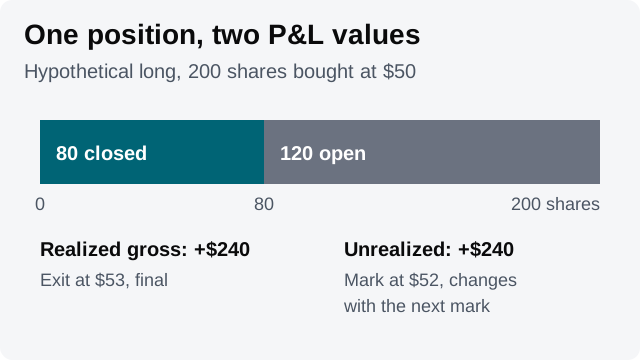
Suppose you buy 200 shares at $50, sell 80 shares at $53, and the remaining 120 shares are marked at $52. This example uses shares with a contract multiplier of one and excludes fees.
Match the closed quantity. The sale closes 80 of the 200 shares.
Calculate realized gross P&L for those 80 shares: (53 - 50) × 80 = $240.
Calculate unrealized P&L for the remaining 120 shares: (52 - 50) × 120 = $240.
Keep the two values separate. The trade has $240 realized gross P&L and $240 unrealized P&L at the stated mark.
Hypothetical trade. The closed and open quantities are valued separately: the realized part at the exit price, the open part at the mark.
If you later sell the remaining 120 shares at $51.50, the second close realizes (51.50 - 50) × 120 = $180. The final gross realized P&L is $420, and unrealized P&L is no longer present because the position is flat.
For a short position, the favorable price direction is reversed. For instruments such as futures, forex, crypto, and CFDs, price movement must be converted through the instrument's configured tick, point, lot, or contract values. A stock formula should not be copied across instrument types.
Tradeways calls the marked value of the open quantity running P&L. It needs a broker mark. Broker marks currently come only from the Open Positions section of an Interactive Brokers Activity Flex Query, and only for stock and ETF positions. An open trade without a mark shows its realized P&L only. That covers trades from other imports, Interactive Brokers trades imported without the Open Positions section, and positions other than stocks and ETFs.
Take the trade above, before the second sale, with $1 of commission recorded on each of its two executions. You import the executions together with an Open Positions report dated 30 September that marks the stock at $52.
Value in the trade
Calculation
Amount
Realized gross P&L
(53 - 50) × 80
$240
Running P&L at the 30 September mark
(52 - 50) × 120
$240
Gross P&L
240 + 240
$480
Commission
$1 on each of two executions
−$2
Net P&L in the trade header
480 - 2
$478
In the currency display mode, the trade header shows $478 as Net P&L, with "Running P&L · as of" and the report date under it. This figure includes the running part. The date belongs to the mark, not to the moment you open the page. Tradeways uses the report-date mark price from the file, not a live quote, so the running figure stays at $240 until you import a newer report. The unrealized P&L in the broker file is kept for comparison only; Tradeways recalculates running P&L from the open FIFO lots in your journal.
The running part also stays out of results that need a final outcome. The calendar, win rate, and other statistics count closed trades only. The account balance includes the last available running P&L for marked open positions and says so when it does.
When the position is closed, the mark is removed. If the second sale at $51.50 also carries $1 of commission, Net P&L becomes the final $420 gross minus $3 commission, or $417, and the running label disappears.
When a position has entries at different prices, the matching method determines which entry quantity an exit closes. Tradeways uses first in, first out, or FIFO, so the oldest open quantity is matched first.
Consider two entries of 100 shares, the first at $50 and the second at $54. A sale of 120 shares at $55 closes all 100 shares from the $50 entry and 20 shares from the $54 entry under FIFO. The remaining open quantity is 80 shares from the second entry. Realized P&L comes from the two matched portions. Unrealized P&L uses the remaining 80 shares and the current mark.
If another platform uses a different matching method, its realized and unrealized split can differ before the position is fully closed. Compare the executions, matching method, and remaining lots before treating either result as wrong.
Gross realized P&L is the result from matched price movement before commission.
Net realized P&L includes supported commission and adjustments.
Unrealized P&L values the open quantity at a mark.
Total marked P&L combines realized P&L with unrealized P&L only when their currency and cost treatment match.
Fees can arrive in another currency or on another date. If a required conversion rate is unavailable, a journal may exclude that amount and mark the total as incomplete. An incomplete total is not zero.
A trade can therefore finish with one realized result while showing different MFE and MAE values. If market data is missing or calculation work is incomplete, those excursion metrics can remain pending. Keep that provenance visible rather than treating a missing metric as zero.
Tradeways calculates realized P&L from matched executions and can add marked open P&L when a mark is available. In Trade Detail, compare the executions, gross and net values, adjustments, and excursion status before using the number in a review.