A rate decision is rarely the news. The news is what changed since the last one: the guidance, the votes, the projections, the balance sheet. This is how to read a policy statement the way desks do, by comparison.
We use cookies, including analytics, to improve Tradeways. · Privacy
When a central bank publishes a policy statement, most coverage leads with the headline rate: held, cut twenty-five, hiked twenty-five. That number is usually the least surprising thing in the document. The market has often priced it for weeks. What actually moves currencies, bonds, and equities is the part that changed since the last meeting: a softened sentence, a new data dependency, a shifted dot plot, a widening vote split.
Reading a statement well is really an exercise in comparison rather than reading. The rest of this guide walks through how to run that comparison the way a policy desk does, and how to turn the result into a clear, defensible read.
The change from the earlier release is more important than the later release read in isolation.
When a bank keeps using the same language, little has changed and there is little to reprice. When its wording, projections, votes, instruments, or areas of emphasis change, the market may need to reprice the expected path of policy. That is where the move comes from.
So for every statement, keep three questions separate:
What does the bank currently say and do?
What changed relative to the earlier release?
Was that change already expected and priced in?
With two statements in front of you, you can answer the first two. The third usually needs expectations or pricing data you may not have, so do not claim a release was a "surprise" unless you can actually show what the market expected.
Use the full official release, not a headline or a summary. And be precise about what you are comparing, because these documents are not interchangeable:
A statement or rate decision describes the formal decision and its immediate reasoning.
Minutes provide the detail of the discussion, and arrive weeks later.
Projections and dot plots describe participants' expectations, and are not attached to every meeting.
A press conference often carries the real signal about the next few meetings.
Implementation and balance-sheet notes cover the mechanics.
Comparing a statement to a set of minutes, or one meeting's projections to another meeting that had none, produces phantom "changes" that are really just differences in document type. Match like with like.
Work through the same areas every time. A statement can hold the rate flat and still be meaningfully hawkish or dovish because of what happened in one of these rows.
Area
What to look for
Policy action
Rate or range, and separately: QE/QT, purchase pace, reinvestment, balance-sheet runoff, special programs
Forward guidance
More hikes, a pause, "higher for longer", earlier or later cuts, a new trigger for the next move
Inflation
Above or below target, rising or moderating, headline vs. core, which components the bank names, forecast path
Growth & labor
Activity and GDP, employment and wages, demand, credit conditions, and the bank's stated priority among them
Votes
Unanimous or split, how many dissented, and whether dissenters wanted tighter or easier policy
Projections
The expected rate path, inflation and growth forecasts, and shifts in the distribution of expectations
Newly emphasized data
What the bank now says it is watching — a move from inflation to employment tells you what confirms or breaks the new stance
Two rules make this reliable. First, do not judge the release from the headline rate alone: an unchanged rate with a faster balance-sheet runoff is a tightening. Second, treat different programs separately instead of collapsing everything into one "balance sheet" bucket.
Once you have the differences, assign one qualitative label, and state it as a comparison rather than an absolute:
Hawkish: the later release points to tighter policy, higher rates, less liquidity, or restriction lasting longer.
Dovish: it points to easier policy, lower rates, more liquidity, or earlier easing.
Unchanged: no meaningful policy-direction change.
Mixed: meaningful hawkish and dovish changes coexist and neither clearly dominates.
Say "hawkish relative to the April release", not simply "hawkish". And resist the urge to score the statement by counting positive and negative words. A read is decided by the two or three changes that actually matter: a shifted guidance sentence outweighs a dozen unchanged paragraphs. Support the label with those specific changes and explain why they matter.
Keep the communication rating separate from any market forecast. They are different claims, and only the first is fully supported by two statements.
Currency. Higher or longer-lasting rates generally support a currency; lower rates weaken it. But FX is relative: a pair also depends on the other bank, the rate differential, existing pricing, and intervention risk. One bank's statement describes that bank's change, not a confident call on the pair.
Bonds. Tighter policy generally weighs on bond prices and lifts yields; easier policy does the reverse. Price and yield move in opposite directions.
Equities. Higher expected rates can pressure equities as financing costs rise and bonds compete for capital. But growth cuts both ways: stronger GDP helps earnings even as it argues for tighter policy.
The move from "the change is hawkish" to "therefore the currency rallies today" crosses from what you can support into what you are guessing. Make that boundary explicit rather than blurring it.
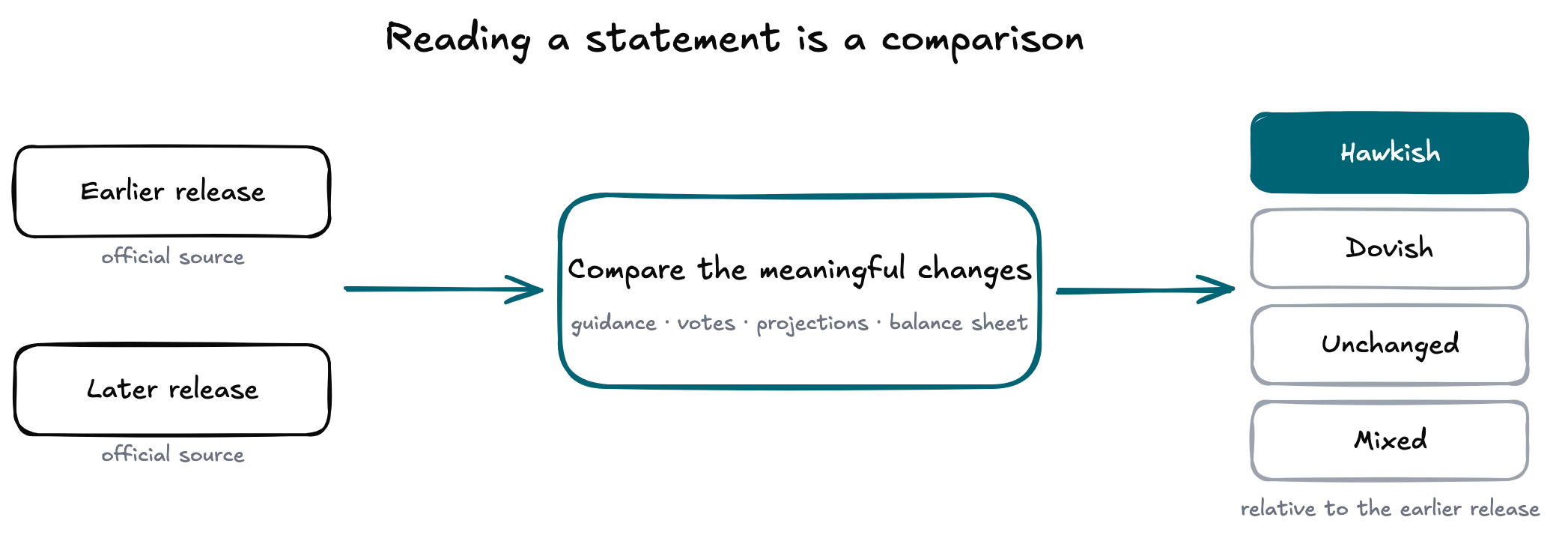
Every statement read reduces to the same shape: two official releases in, the meaningful differences extracted, one qualitative rating out.
The whole method in one shape: compare two official releases, isolate what changed, and rate the change rather than the statement in isolation.
That is exactly the workflow behind our free tool. Tradeways Macro takes the two canonical releases from a central bank, computes the exact wording changes between them, and pairs that deterministic redline with a clearly labeled interpretation, so the diff is authoritative and the reading is transparent. You can browse the latest decisions or check the policy calendar for what's scheduled next.
Compare the later release with the earlier one; never rate it in isolation.
Read the full release, not only the headline rate.
Give forward guidance, votes, projections, and balance-sheet changes their proper weight.
Follow the variables the bank itself says are important.
Look beneath headline inflation, labor, and GDP when the release provides the detail.
Preserve conflicting signals instead of forcing certainty.
Separate the communication change from market expectations and pricing.
Separate the policy direction from the eventual price reaction.
Don't add facts, expectations, or probabilities that aren't in the release.
Do this consistently across a few meetings from the same bank and the changes start to jump out on first read. The language becomes familiar, and the one sentence that moved becomes obvious against the paragraphs that didn't.