블로그
Hawkish vs. Dovish: What They Actually Mean
Two words carry most of the meaning in central-bank commentary. Hawkish leans toward tighter money; dovish leans toward easier money. The nuance, and the mistakes, come from what they are measured against.
읽기 3분Tradeways#기초#용어집
This translation is not available yet — you are reading the original in English.
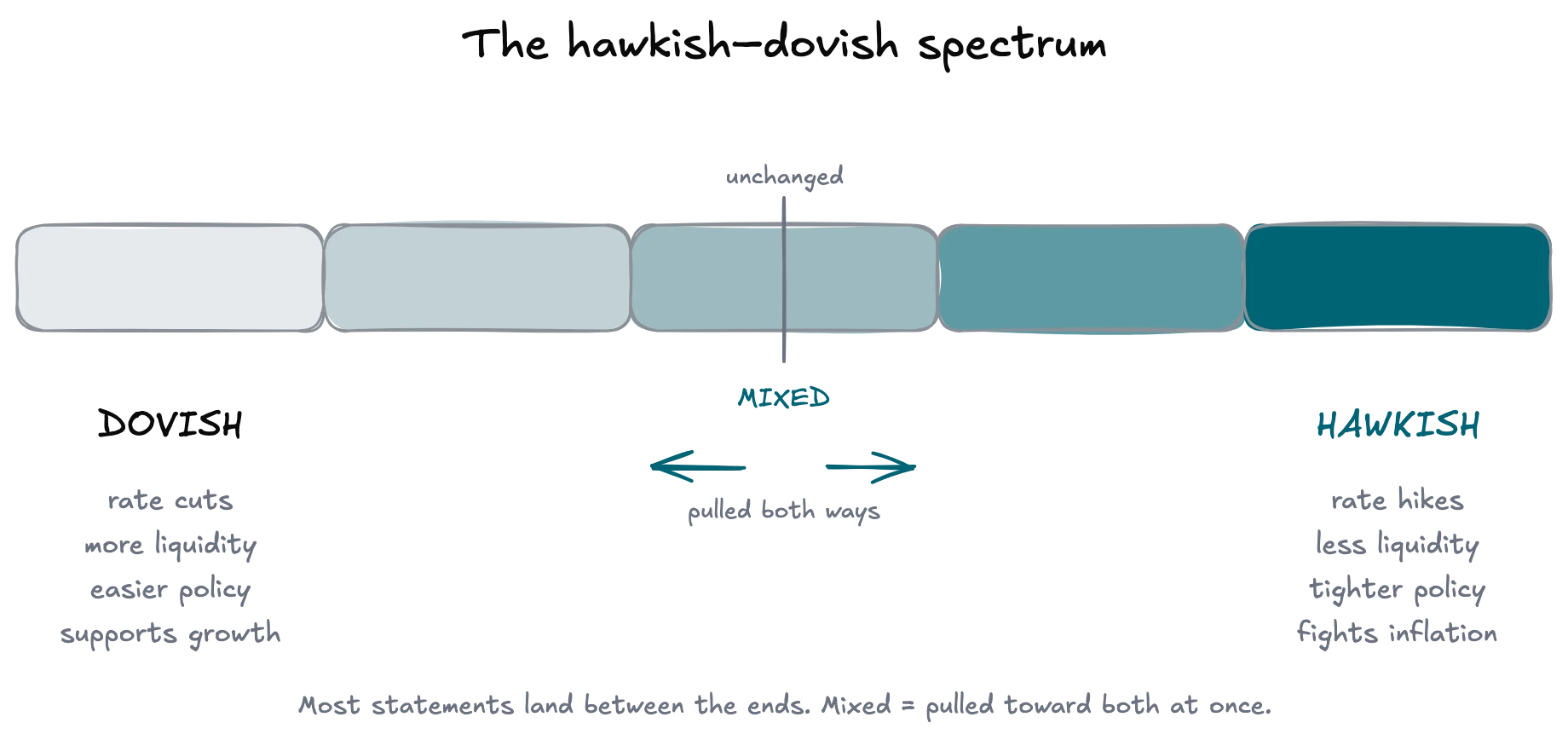
Two words do most of the work in central-bank commentary. Hawkish describes a lean toward tighter money: higher rates, less liquidity, or restriction that lasts longer. Dovish describes the opposite lean, toward lower rates, easier money, or an earlier end to restriction. Almost every take on a policy statement is, underneath, an attempt to place it somewhere between those two poles.
The words are simple. The mistakes come from forgetting what they are measured against.
The spectrum
Policy signals aren't binary. They sit on a spectrum, and most real statements land somewhere between the extremes rather than on them.

- Hawkish signals: hiking rates, guiding toward more hikes or "higher for longer", shrinking the balance sheet faster, emphasizing persistent or broadening inflation, or highlighting a labor market so tight it sustains price pressure.
- Dovish signals: cutting rates, guiding toward earlier cuts, slowing or ending balance-sheet runoff, expressing confidence that inflation is returning to target, or emphasizing weakening growth and employment.
Hawkish and dovish about what?
This is the distinction that separates a good read from a bad one: these words describe a direction of change, and direction only means something relative to a reference point.
A bank can be running deeply restrictive policy and still deliver a dovish statement, as long as it signals that restriction will ease sooner than it previously implied. The absolute stance is still tight. The change is dovish. Both are true at once, and they answer different questions:
- Where is policy? The level: restrictive, neutral, or accommodative.
- Which way did it just move? The change: hawkish, dovish, or unchanged.
Where the labels actually come from
A rate move is the loudest signal but rarely the whole story. A statement can hold the rate and still read clearly hawkish or dovish through:
- Forward guidance: the expected path often matters more than the current decision. A fully-expected hold with guidance pointing to earlier cuts is a dovish meeting.
- Votes: an unchanged decision can turn hawkish if more members dissent toward tightening.
- Projections and dot plots: a shifted rate path or inflation forecast can carry more information than the headline rate.
- The balance sheet: a faster runoff or slower purchases is a tightening even with the rate on hold.
- Emphasis: when a bank moves its stated focus from inflation to employment, it is telling you what would justify easing next.
When neither wins: mixed
Real decisions often carry opposing pressures: high inflation against weak growth, a hike alongside continued asset purchases, soft activity with sticky wages. When meaningful hawkish and dovish changes coexist and neither clearly dominates, the honest label is mixed. Forcing a clean hawkish-or-dovish call on a genuinely conflicted statement is how confident-sounding reads end up wrong.
Reading it in practice
When you place a statement on the spectrum, do it as a comparison and say so: "dovish relative to the previous meeting", not just "dovish". Support the label with the two or three changes that actually decided it, and keep the policy read separate from any market call. Higher rates tend to support a currency, but that's a different, less certain claim than "the guidance shifted hawkish".
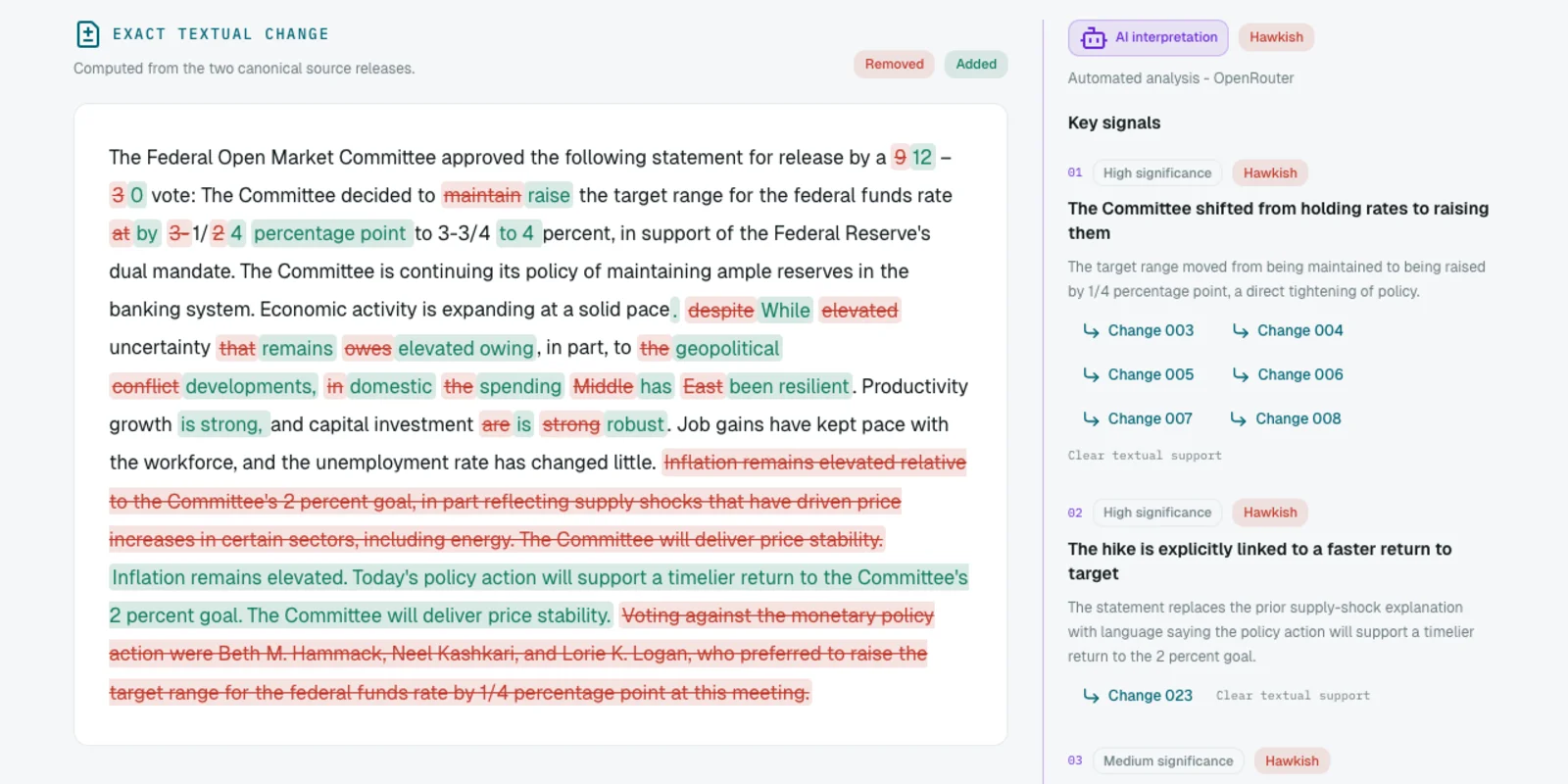
Our free tool, Tradeways Macro, does exactly this for each central bank: it computes the exact wording changes between a bank's two most recent releases and labels the direction (hawkish, dovish, unchanged, or mixed) with the changed text as the evidence. It's a fast way to see where each latest decision lands on the spectrum.
For the full method behind the label, read how to read a central bank statement. For why the direction of change beats the statement itself, see why the change matters more than the statement.
관련

MFE, MAE, MCE 읽는 법
청산된 모든 Trade는 세 가지 숫자로 설명할 수 있어요. 가장 좋았던 지점, 가장 위협적이었던 지점, 그리고 청산한 뒤의 움직임이에요. 이 셋이 함께 당신의 청산이 구조적이었는지 아니면 운이 좋았는지를 말해 줘요.
읽기 5분
진입 전 필터로서의 시장 국면
같은 Setup이라도 한 국면에서는 이기고 다른 국면에서는 집니다. 국면 분류는 트레이드 후가 아니라 전에 하세요.
읽기 11분
Maximum Favorable Excursion (MFE)
청산하기 전에 트레이드가 도달했던 최대 미실현 수익, 그리고 실현 P&L과의 차이가 당신의 청산에 대해 알려주는 것.
읽기 8분