We use cookies, including analytics, to improve Tradeways. · Privacy
The same setup wins in one regime and loses in another, and most setup post-mortems are really regime post-mortems. The fix is to classify the regime before the trade, not after. A clean fade against the high-of-day is a positive-expectancy trade on one tape and a structural loser on the next, and the only thing that changed is the regime around it.
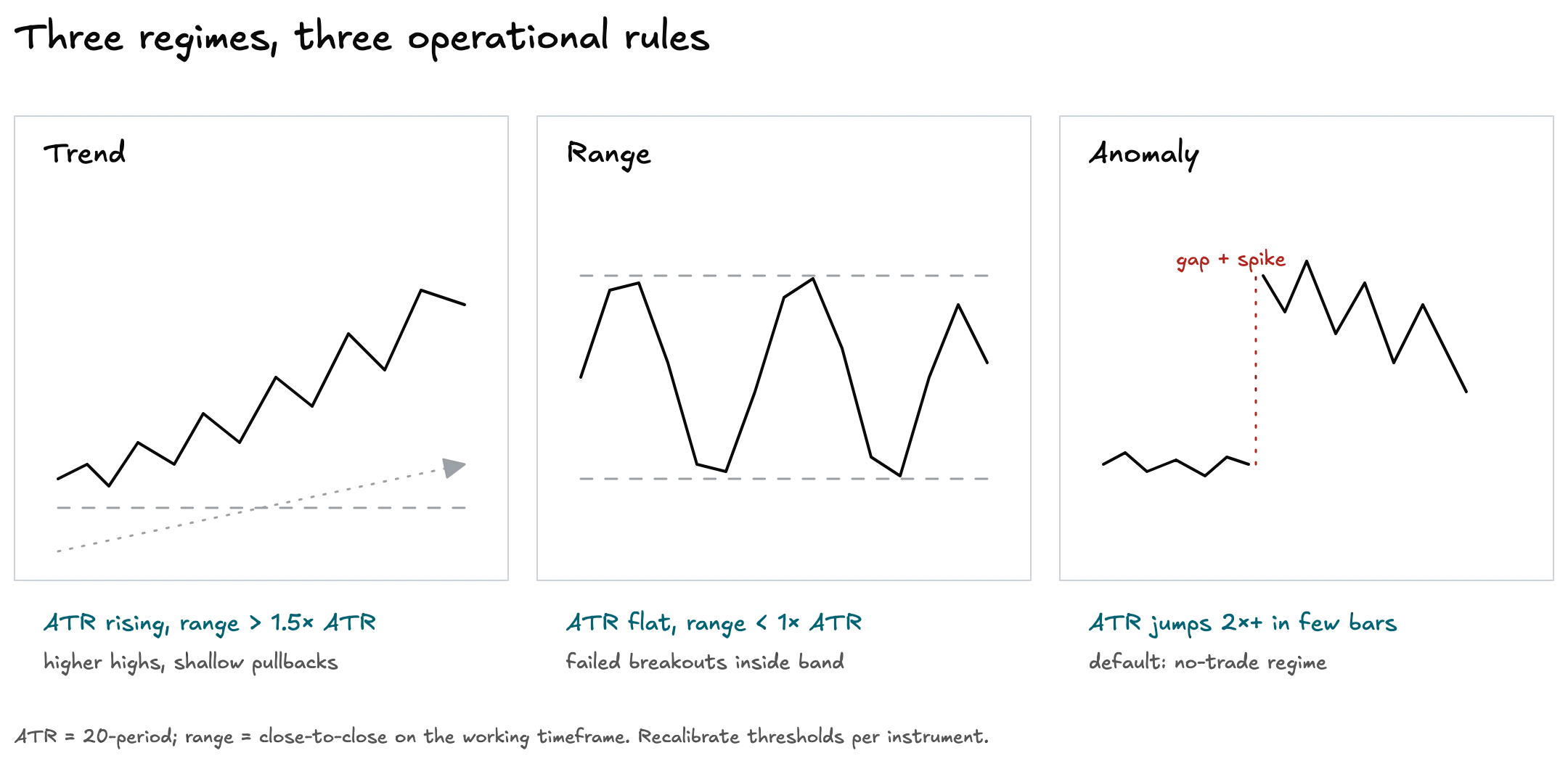
We work with three. They are defined operationally, on numbers you can read off the chart, not on intuition.
Trend. Directional drift dominates noise. Operational read: the 20-period ATR is rising or stable while the close-to-close range over the same window exceeds 1.5× ATR. Higher highs and higher lows on the working timeframe. Pullbacks are shallow and finish above the prior swing low. VWAP carries a clear slope and price holds one side of it for most of the session.
Range. Price oscillates inside a defined band. ATR is contracting or flat. The close-to-close range sits below 1× ATR, meaning the body of the move is smaller than the average bar. Breakouts over the last N bars (we use N = 20 on the working timeframe) failed and reverted into the band within a handful of bars. Price crosses VWAP repeatedly.
Anomaly. ATR jumps suddenly, often by 2× or more in a few bars, typically after a news print, an open, or a liquidity vacuum. Gaps through prior structure. Spreads widen. The volume profile fragments into thin clusters with no coherent point of control. Default treatment: no-trade regime, unless the setup is explicitly built for it and the size has been pre-cut.
The thresholds are not sacred (1.5×, 1×, 20-period). They are the numbers we use on NQ on a 5-minute working timeframe. Recalibrate them for your instrument and timeframe. What matters is that the rule is mechanical and the same number gets computed on every day, so the classification is auditable in the journal.
Three regimes, three operational rules. Compute the rule before the first trade and the day classifies itself.
Setups do not have expectancy in the abstract. They have expectancy in a regime.
A mean-reversion fade against the high-of-day is a positive-expectancy trade in Range, a coin flip in Trend, and a stop-out in Anomaly. Same entry trigger, same stop, three different outcomes, because the auction that catches the fade only exists when ATR is contracting and the breakout above the prior high failed. In Trend, the same trigger fires while the breakout is real and the higher high is the next bar's open. In Anomaly, the stop gets blown through before the order fills.
The reverse is true for continuation. A breakout-pullback long is the bread of the Trend regime and the slow leak of the Range regime. In Range it triggers exactly where the failed breakouts cluster, and you take small loss after small loss in the place where you are statistically most likely to be wrong. The setup did not break. You took it in the wrong regime.
When a profitable system stops working, the regime usually moved before the system did. The trader concludes the edge is dead. The journal, if it tags regime on every trade, shows the edge is intact inside its native regime and the recent losses all sit in the foreign one.
Continuation moves cluster in trend regimes. That is not a stylistic claim, it is the definition of the regime. If you tag trades with MCE, the high-MCE tail concentrates on trend days, because that is where the post-exit drift has somewhere to go.
The practical consequence: when you slice MCE by setup and find a setup with a fat positive tail, the next slice is by regime. If the high-MCE trades are almost all trend-regime trades, the exit rule is not failing at random. The exit is sized for the average regime and gets clipped by the trend regime, which is exactly the regime where the setup's continuation lives. The fix is regime-aware: a longer hold, a trailing stop, or simply a different exit on trend days. The metric was already telling you. Regime is what makes the signal readable.
This is a 30-second discipline, not an analytical exercise. The regime number is already computed by the time the bar closes. The expectancy-by-regime number is already in the journal. Step (c) is the only one that requires character.
Regime transitions are obvious in retrospect and slippery in real time. The ATR rule is lagging by construction. You will see the trend regime confirm itself two bars after the move that established it. That gap is unavoidable. What is avoidable is pretending the gap does not exist.
We build a transition flag into the same calculation. When the 20-period ATR changes direction (rising after falling, or falling after rising) and the close-to-close range sits between 1× and 1.5× ATR, neither rule is firing cleanly. That is the in-between. The rule then is not "pick a regime and commit," it is "halve size, halve frequency, and wait." A halved position survives a wrong regime call. A full-size position taken on an unclear classification is the trade that wipes out the week's gains in the place where you had the least information.
The honest version is: the regime is always a probability, not a fact. The point of the operational rule is not to make it a fact, it is to make the probability the same number every day, so the trades from this Tuesday are comparable to the trades from last Tuesday and the journal can do its job. The trader who classifies every day with the same rule and stands down on the unclear ones outperforms the trader who reads the tape brilliantly on three days a year.