首頁

Blog

Hawkish vs. Dovish: What They Actually Mean

Two words carry most of the meaning in central-bank commentary. Hawkish leans toward tighter money; dovish leans toward easier money. The nuance, and the mistakes, come from what they are measured against.

閱讀時間 3 分鐘Tradeways#基礎#術語表

This translation is not available yet — you are reading the original in English.

Two words do most of the work in central-bank commentary. Hawkish describes a lean toward tighter money: higher rates, less liquidity, or restriction that lasts longer. Dovish describes the opposite lean, toward lower rates, easier money, or an earlier end to restriction. Almost every take on a policy statement is, underneath, an attempt to place it somewhere between those two poles.

The words are simple. The mistakes come from forgetting what they are measured against.

The spectrum

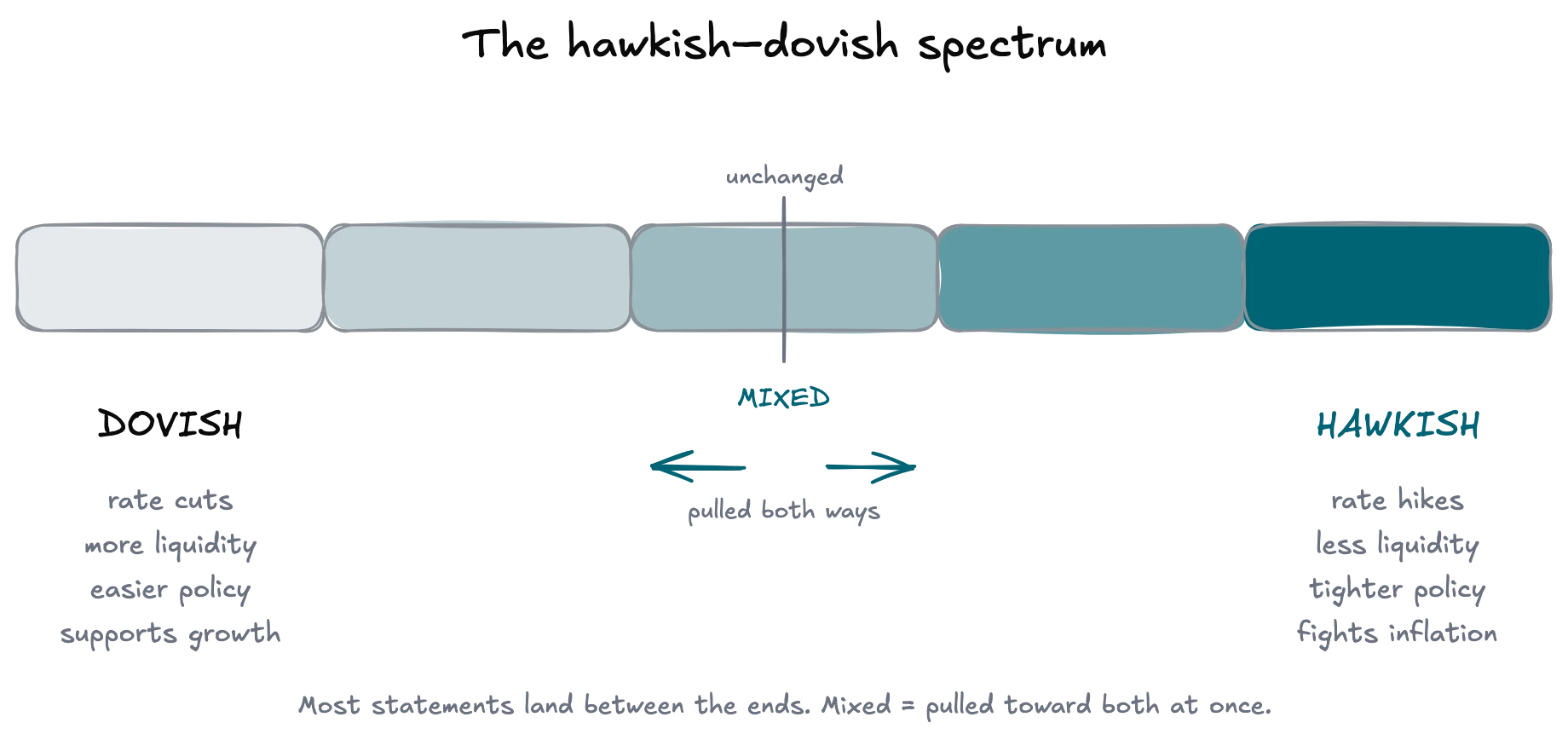
Policy signals aren't binary. They sit on a spectrum, and most real statements land somewhere between the extremes rather than on them.

A horizontal spectrum from dovish on the left to hawkish on the right. The dovish end lists rate cuts, more liquidity, easier policy, and support for growth. The hawkish end lists rate hikes, less liquidity, tighter policy, and inflation-fighting. The center is marked unchanged, with mixed shown as pull in both directions.
Hawkish and dovish are the two ends of one scale. Unchanged sits in the middle; mixed is when a statement pulls toward both ends at once.
  • Hawkish signals: hiking rates, guiding toward more hikes or "higher for longer", shrinking the balance sheet faster, emphasizing persistent or broadening inflation, or highlighting a labor market so tight it sustains price pressure.
  • Dovish signals: cutting rates, guiding toward earlier cuts, slowing or ending balance-sheet runoff, expressing confidence that inflation is returning to target, or emphasizing weakening growth and employment.

Hawkish and dovish about what?

This is the distinction that separates a good read from a bad one: these words describe a direction of change, and direction only means something relative to a reference point.

A bank can be running deeply restrictive policy and still deliver a dovish statement, as long as it signals that restriction will ease sooner than it previously implied. The absolute stance is still tight. The change is dovish. Both are true at once, and they answer different questions:

  • Where is policy? The level: restrictive, neutral, or accommodative.
  • Which way did it just move? The change: hawkish, dovish, or unchanged.

Where the labels actually come from

A rate move is the loudest signal but rarely the whole story. A statement can hold the rate and still read clearly hawkish or dovish through:

  • Forward guidance: the expected path often matters more than the current decision. A fully-expected hold with guidance pointing to earlier cuts is a dovish meeting.
  • Votes: an unchanged decision can turn hawkish if more members dissent toward tightening.
  • Projections and dot plots: a shifted rate path or inflation forecast can carry more information than the headline rate.
  • The balance sheet: a faster runoff or slower purchases is a tightening even with the rate on hold.
  • Emphasis: when a bank moves its stated focus from inflation to employment, it is telling you what would justify easing next.

When neither wins: mixed

Real decisions often carry opposing pressures: high inflation against weak growth, a hike alongside continued asset purchases, soft activity with sticky wages. When meaningful hawkish and dovish changes coexist and neither clearly dominates, the honest label is mixed. Forcing a clean hawkish-or-dovish call on a genuinely conflicted statement is how confident-sounding reads end up wrong.

Reading it in practice

When you place a statement on the spectrum, do it as a comparison and say so: "dovish relative to the previous meeting", not just "dovish". Support the label with the two or three changes that actually decided it, and keep the policy read separate from any market call. Higher rates tend to support a currency, but that's a different, less certain claim than "the guidance shifted hawkish".

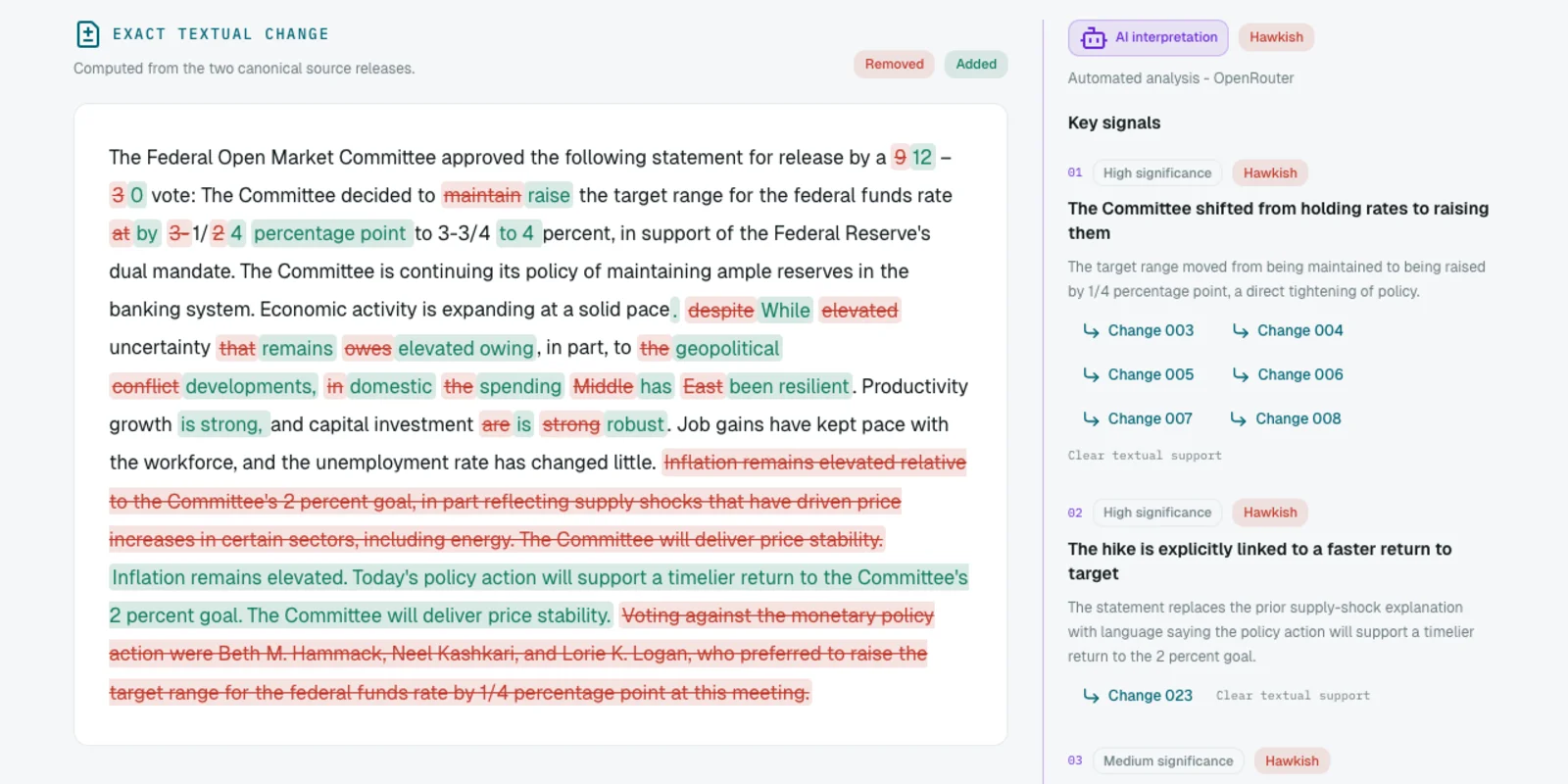
Our free tool, Tradeways Macro, does exactly this for each central bank: it computes the exact wording changes between a bank's two most recent releases and labels the direction (hawkish, dovish, unchanged, or mixed) with the changed text as the evidence. It's a fast way to see where each latest decision lands on the spectrum.

For the full method behind the label, read how to read a central bank statement. For why the direction of change beats the statement itself, see why the change matters more than the statement.

相關

  1. 解讀 MFE、MAE 與 MCE

    每一筆平倉的 Trade 都能用三個數字來描述:它最好曾走到哪裡、最糟曾威脅到什麼程度,以及你出場之後它又怎麼走。把這三者合在一起,就能看出你的出場究竟是結構性的判斷,還是純粹運氣好。

    閱讀時間 4 分鐘
  2. 把市場盤勢當成下單前的篩選器

    同一個 Setup,在某個盤勢中賺錢,在另一個盤勢中卻賠錢。在下單「之前」就先把盤勢分類,而不是事後才檢討。

    閱讀時間 9 分鐘
  3. Maximum Favorable Excursion(MFE)

    一筆 Trade 在你平倉前所達到的最佳未實現獲利,以及它與已實現 P&L 之間的差距,能告訴你哪些關於出場的訊息。

    閱讀時間 7 分鐘

我們會使用 Cookie(包含分析用途)來改善 Tradeways。 · 隱私權